BNZ – BusinessNZ
Performance of Manufacturing Index

BNZ – BusinessNZ
Performance of
Manufacturing Index

Mid year blues – PMI

49.7

June

-2.9

Monthly Change

contracting

previously expanding

New Zealand’s manufacturing sector fell back into contraction for the first time since the most recent national lock-down in August 2021, according to the latest BNZ – BusinessNZ Performance of Manufacturing Index (PMI).

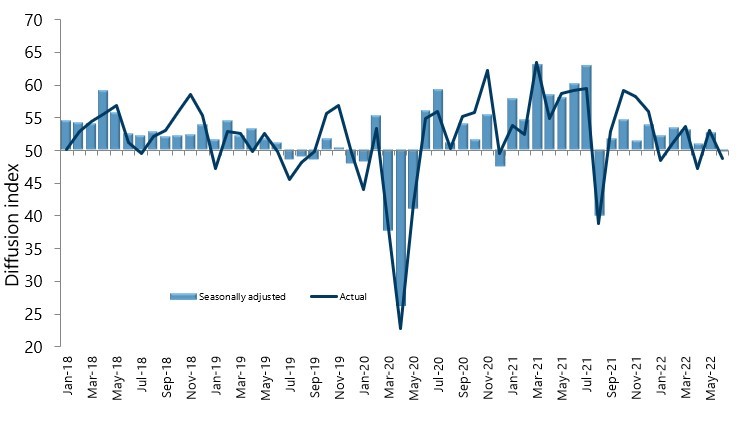
The seasonally adjusted PMI for June was 49.7 (a PMI reading above 50.0 indicates that manufacturing is generally expanding; below 50.0 that it is declining).  This was 2.9 points lower than May, and well below the long-term average of 53.1 for the survey.

BusinessNZ’s Director, Advocacy Catherine Beard said that the drop in activity levels for June highlights the fact that the sector remains in struggle street to get back to long-term activity levels.  

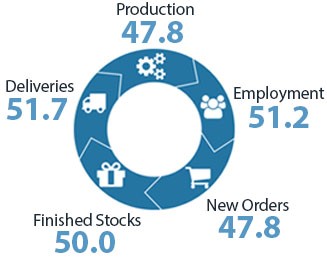
“The key sub index values of Production (47.8) and New Orders (47.8) both recorded the same level of contraction, which had a combined negative effect on the overall Index.  As mentioned in previous months, a strong and consistent activity level for both these key sub index values will be the only way to push the PMI towards better results.”

Manufacturers continue to have a more negative mindset, with the June result showing 68.5% provided negative comments.  While this was down from 72.7% in May and 70.3% in April, staff retention/shortages continue to plague the sector, as does supply chain issues.

BNZ Senior Economist, Doug Steel stated that “June’s weak PMI adds a note of caution and certainly supports our broader concern about economic growth ahead”.
Catherine Beard

Director, Advocacy BusinessNZ

Manufacturing Snapshot

The PMI

The Performance of Manufacturing Index lost momentum in June, slipping to 49.7. This follows nine consecutive readings above the breakeven 50 mark, including May’s 52.6.
Read more

Demand softening

There are changes afoot regards demand. After reaching a recent peak of 58.6 in March, the new orders index has progressively taken material steps downward to now be outright contractionary at 47.8 in June.
Read more

Challenges – old and new

Supply side challenges persist and continue to dominate PMI respondent comments to the negative. Labour shortages remain a frustration for many.
Read more

Growth and policy

We continue to expect a decent bounce in Q2 GDP, following restriction-induced weakness in Q1. But June’s weak PMI adds a note of caution and certainly supports our broader concern about economic growth ahead.
Read more

Doug Steel

Senior Economist, BNZ

Sponsor Statement

BNZ is delighted to be associated with the Performance of Manufacturing Index (PMI) and BusinessNZ.

This association brings together the significant experience of leading business advocacy body BusinessNZ, and business finance specialist BNZ.

We look forward to continuing our association with BusinessNZ and associated regional organisations, and to playing our part in the ongoing development of the New Zealand manufacturing sector.

PMI Time Series Table

The results are seasonally adjusted

National Indicies Jun
2021
Feb
2022
Mar
2022
Apr
2022
May
2022
Jun
2022
BNZ – BusinessNZ PMI 60.2 53.4 53.2 51.0 52.6 49.7
Production 62.3 51.5 50.3 49.3 52.6 47.8
Employment 56.3 51.9 52.2 49.7 52.8 51.2
New Orders 63.7 58.2 58.6 54.8 52.3 47.8
Finished Stocks 57.2 50.0 53.2 53.8 52.8 50.0
Deliveries 53.8 52.8 51.3 49.6 55.1 51.7

BNZ - BusinessNZ PMI Time Series

June 2018 – June 2022

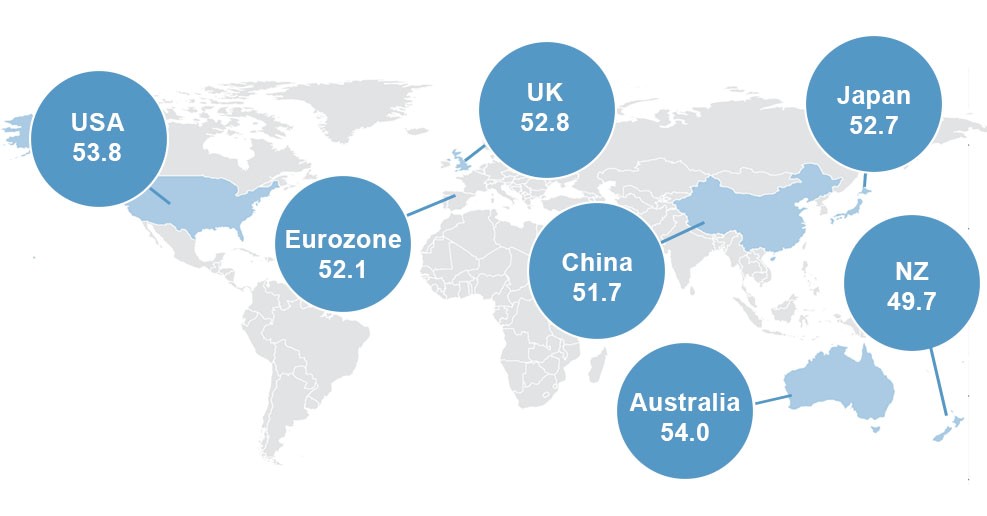
International Results

J.P. Morgan Global Manufacturing PMI

01 Jul 2022
52.2

Stephen Summers

Economist, BusinessNZ

About The PMI

The BNZ – BusinessNZ Performance of Manufacturing Index is a monthly survey of the manufacturing sector providing an early indicator of activity levels.

A PMI reading above 50 points indicates manufacturing activity is expanding; below 50 indicates it is contracting.

The main PMI and sub-index results are seasonally adjusted.

Technical Contact

Mark Cox
Economist, BusinessNZ

[email protected]

Our Contributors

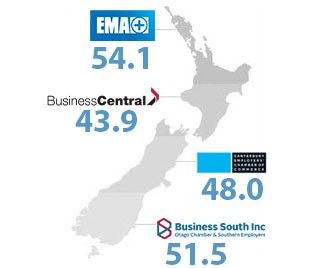
The BNZ – BusinessNZ PSI contains data obtained through BusinessNZ’s regional organisations